
Stainless steel is a durable and versatile iron-based alloy valued for its strength and high resistance to rust and corrosion. Among the many grades available, Type 304 and Type 316 are the most widely used. At first, they may seem nearly identical, but subtle differences in their chemical makeup create significant variations in performance. These distinctions influence where and how each grade is best applied. This guide highlights the key differences between 304 vs 316 stainless steel to help you determine which option is best suited for your project.

Overview of Stainless Steel
Stainless steel is a group of iron-based alloys best known for its ability to resist rust and corrosion. This special quality is achieved by adding chromium. When chromium meets oxygen, it creates a super-thin, invisible shield called a passive layer. Even if scratched, this layer heals itself, which is why stainless steel stays shiny and durable for so long.
Stainless steels are divided into different families, each with its own personality and uses:

1. Austenitic
The most common type, which includes the popular Grades 304 and 316. These stand out for their excellent corrosion resistance, ease of shaping, and non-magnetic nature.
2. Ferritic
Magnetic and affordable, ferritic steels offer decent corrosion resistance but are not as tough or flexible as austenitic steels.
3. Martensitic
Known for strength and hardness, these steels can be heat-treated. They’re often used for tools and knives where sharpness and durability are most important.
4. Duplex
A blend of austenitic and ferritic structures, duplex steels combine strength with corrosion resistance, making them reliable in demanding environments like chemical plants and offshore work.
What is 304 Stainless Steel?
Type 304 stainless steel is the most widely used grade in the stainless family. It’s often nicknamed “18/8” because it’s made with around 18% chromium and 8% nickel. That mix provides strong rust resistance, along with the toughness and flexibility to be shaped into all sorts of products. You’ll find 304 everywhere (from kitchen sinks and cookware to food equipment and building materials) because it’s dependable, affordable, and easy to work with.

What is 316 Stainless Steel?
Type 316 stainless steel, often called marine-grade, is known for its outstanding corrosion resistance. What sets it apart is the addition of molybdenum, a key element that helps it withstand salt, chlorides, and harsh chemicals. While it’s the second most common grade after 304, it is the first choice for tougher environments. You’ll often find 316 in marine settings, chemical plants, and even medical equipment where strength and reliability are essential.
Chemical Composition Comparison
Both 304 and 316 belong to the austenitic family of stainless steels, which means they share many qualities like good corrosion resistance and easy formability. But the real difference comes down to their chemical makeup, which affects how they perform in different environments.
| Element | 304 Stainless Steel (%) | 316 Stainless Steel (%) |
| Chromium (Cr) | 18 – 20 | 16.0 – 18.0 |
| Nickel (Ni) | 8.0 – 10.5 | 10.0 – 14.0 |
| Molybdenum (Mo) | Not present | 2.0 – 3.0 |
| Manganese (Mn) | up to 2.0 | up to 2.0 |
| Silicon (Si) | up to 1.0 | up to 0.75 |
| Carbon (C) | up to 0.07 | up to 0.08 |
| Phosphorus (P) | up to 0.045 | up to 0.045 |
| Sulfur (S) | up to 0.03 | up to 0.03 |
| Iron (Fe) | Balance | Balance |
Understanding the Difference in Corrosion Resistance
When people choose between 304 and 316 stainless steel, corrosion resistance is usually the deciding factor. Both are strong performers, but the extra ingredient in 316 makes all the difference. That small addition (approximately 2–3%) gives 316 a stronger defense against chlorides and harsh chemicals, which are common in places like coastal areas, swimming pools, and industrial plants.
Consider this: 304 is reliable for everyday environments, like kitchens, indoor architecture, or food equipment. However, if the metal is going to face saltwater, de-icing salts, or chemical exposure, 316 is the safer bet. Its ability to resist pitting and crevice corrosion keeps it intact and looking good, even under stress.
304 vs. 316 Corrosion Resistance | ||
| Feature | 304 Stainless Steel | 316 Stainless Steel |
| Main Elements | Chromium, Nickel | Chromium, Nickel, Molybdenum |
| General Resistance | Great for everyday use and mild exposure | Excellent, especially in tough environments |
| Chloride Protection | Can be vulnerable in salty or chemical areas | Highly resistant thanks to molybdenum |
Mechanical Properties and Durability
Both 304 and 316 stainless steels are strong, reliable materials with nearly identical densities, but the small differences in their makeup give 316 a performance edge in more demanding situations.
Strength and Hardness
316 stainless steel, which contains molybdenum, enhances its tensile and yield strength slightly above that of 304. This means it holds up better when exposed to heavy stress or high temperatures. Both types can be further strengthened through cold working, but 316 tends to keep its strength and corrosion resistance more consistently in challenging conditions.

Durability and Longevity
Durability isn’t just about strength; it’s also about how well a material stands up to its environment. In everyday, non-aggressive settings, 304 lasts a long time without issue. But in salty air, coastal regions, or chemical-heavy spaces, 316 clearly outperforms.
| Property | 304 Stainless Steel | 316 Stainless Steel |
| Density | ∼8.03 g/cm³ | ∼8.00 g/cm³ |
| Tensile Strength | 505–620 MPa | 515–655 MPa |
| Yield Strength | 215–310 MPa | 240–325 MPa |
| Overall Durability | Very good for general use, less suited for salty environments | Superior for marine, coastal, and chemical-heavy conditions |
Temperature Performance
Both 304 and 316 stainless steels can withstand high temperatures very well. They have the same melting points and can tolerate high temperatures without losing much of their strength.
The main difference shows up when heat and corrosive conditions are combined. 316 holds its resistance better in these tough environments, which means it is the safer choice for continuous exposure to chemicals, salts, or acids at elevated temperatures.
| Property | 304 Stainless Steel | 316 Stainless Steel |
| Max Intermittent Service Temp | ∼870 °C (1598 °F) | ∼870 °C (1598 °F) |
| Max Continuous Service Temp | ∼925 °C (1697 °F) | ∼925 °C (1697 °F) |
| High-Temp Corrosive Environments | Good, but can face intergranular corrosion | Excellent, resists corrosion longer |
Cost and Price Differences
One of the primary reasons people opt for 304 over 316 is its low cost. On average, 304 stainless steel costs about 20–30% less than 316. The main reason? 316 contains molybdenum, a pricey alloying element that boosts corrosion resistance but also raises production costs.
For projects in mild conditions, that price gap makes 304 the smart, budget-friendly choice. However, in harsh or corrosive environments, 316 often pays for itself by lasting longer and reducing the need for repairs or replacements.
| Factor | 304 Stainless Steel | 316 Stainless Steel |
| Upfront Cost | ~20–30% lower | ~20–30% higher |
| Long-Term Value | Affordable, reliable for everyday use | Longer-lasting in tough environments |
Applications and Use Cases
The decision to use 304 or 316 stainless steel often comes down to where the material will live and what it will face. Each grade shines in its own environment, making it popular across different industries.
304 Stainless Steel
As the most common and versatile grade, 304 is the go-to choice when you want strong corrosion resistance at a reasonable cost. It’s easy to shape, weld, and fabricate, which makes it practical for everyday projects.

Typical Uses:
- Kitchen and Food Equipment – sinks, countertops, pots, and pans.
- Architecture – trims, panels, and decorative features in mild environments.
- Chemical Containers – for carrying or storing non-corrosive liquids.
- Automotive Trim – durable moldings and finishes with a clean look.
316 Stainless Steel
Nicknamed marine-grade, 316 is chosen for its ability to withstand chemicals and harsh outdoor conditions. The added molybdenum keeps it from breaking down in places where 304 might struggle.
Typical Uses:
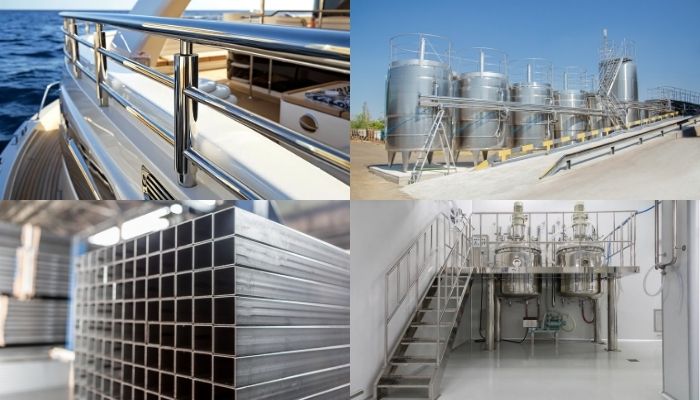
- Marine Hardware – boat railings, fittings, and coastal fixtures.
- Chemical and Pharmaceutical Processing – tanks, pipes, and equipment exposed to aggressive agents.
- Medical Tools and Implants – surgical instruments and implants that need to withstand sterilization.
- Food Processing in Salty Conditions – equipment for handling foods with high salt content.
- Outdoor Fixtures – structures in areas exposed to sea spray, de-icing salts, or pollution.
Maintenance and Lifespan
How long stainless steel lasts depends on its environment and how well it’s cared for. Both 304 and 316 are durable choices, but their maintenance needs and lifespans aren’t quite the same.
304 Stainless Steel
Maintenance: In mild settings, 304 is easy to care for, usually just a quick wipe with soap and water. In places with salt or heavy pollution, it needs more attention to avoid surface rust.
Lifespan: In clean, non-corrosive environments, 304 can last for decades. However, in chloride-rich areas, its lifespan drops quickly as pitting and corrosion set in.
316 Stainless Steel
Maintenance: 316 requires less upkeep, even in harsher environments. While routine cleaning is still recommended, it holds up better against salt, acids, and other corrosive agents.
Lifespan: 316 shines in tough conditions, staying strong and intact for decades. With basic care, it can often last 50 years or more in marine, coastal, or chemical environments, which makes it a smart long-term choice.

Similarities Between 304 vs 316 Stainless Steel
Even though 304 and 316 are often chosen for different environments, they share a lot in common, which is why both are so widely used.
1. Austenitic Family
Both belong to the austenitic group of stainless steels. This gives them their strength, durability, and non-magnetic nature in most cases. They can’t be hardened by heat, but they do get stronger when cold worked.
2. Appearance and Finish
To the eye, they look the same, bright, smooth, and shiny. Without a test, you wouldn’t be able to tell them apart. That’s why both are used in everything from consumer goods to architectural designs.

3. Shared Properties
- Density: Nearly identical, at about 8.0 g/cm³.
- Formability: Easy to shape, bend, and fabricate into different designs.
- Weldability: Both weld beautifully, although 316 may require a bit of extra care due to molybdenum.
- Corrosion Resistance: Both stand up well to general corrosion, making them long-lasting in most everyday environments.
Key Differences: 304 vs 316 Stainless Steel
After looking closely at both grades, here’s a simple side-by-side summary to make the differences easier to see at a glance:
| Feature | 304 Stainless Steel | 316 Stainless Steel |
| Chemical Makeup | 18% Chromium, 8% Nickel, no Molybdenum | 16% Chromium, 10% Nickel, plus 2–3% Molybdenum |
| Corrosion Resistance | Strong overall, but less reliable in salty or chemical-heavy areas | Outstanding, especially in marine and chemical settings |
| Cost | More affordable and widely available | Pricier due to molybdenum and higher nickel content |
| Heat Performance | Performs well under high heat in most conditions | Keeps its strength and resistance even in harsh, hot environments |
| Everyday Uses | Kitchens, food prep, indoor architecture | Boats, pools, coastal railings, medical and chemical gear |
How to Choose Between 304 vs 316 Stainless Steel
Deciding between 304 and 316 doesn’t have to be complicated. Think of it as matching the material to where and how it will be used. Here are three simple things to weigh before making your choice:
1. Look at the Environment
Everyday or Mild Settings: For kitchens, indoor fixtures, or areas with limited exposure to harsh chemicals, 304 is sufficient.
Tough or Corrosive Settings: In areas exposed to saltwater, pools, coastal air, or chemical-heavy environments, 316 is the safer option thanks to its molybdenum boost.

2. Balance Cost and Longevity
On a Budget: If cost matters most and the environment isn’t harsh, 304 gives you strength and durability at a lower price.
For the Long Haul: If replacement or failure would be expensive or risky, 316 pays off over time. Its longer lifespan often makes up for the higher upfront cost.
3. Match It to the Job
304 Works Best For: food prep equipment, sinks, kitchen appliances, decorative trim, and general hardware.
316 Works Best For: marine gear, chemical and pharmaceutical equipment, surgical tools, outdoor fixtures in salty air, and heat exchangers.
How to Identify 304 vs 316 Stainless Steel
304 and 316 look identical. You can’t really tell them apart by sight, which is why a few reliable testing methods are commonly used to confirm the grade:
1. The Molybdenum Drop Test
This is the most common field test. A special solution is applied to the surface of the steel:
If the spot changes color = molybdenum is present, meaning the steel is 316.
If nothing happens = it’s most likely 304, which doesn’t contain molybdenum.
Important: The testing liquid is corrosive and can damage the surface. Always handle it with care and avoid using it on visible or decorative areas.
2. Positive Material Identification (PMI)
For 100% certainty, professionals use PMI testing with devices like X-ray fluorescence (XRF) analyzers. These tools scan the metal and give an exact breakdown of its elements, confirming whether molybdenum (and therefore 316) is present. This is the most accurate method available.

Practical Tip: If you’re not testing the metal yourself, the safest option is to buy from a trusted supplier. Most suppliers will certify material grades in accordance with ASTM or EN standards; Therefore, always request mill test certificates (MTC) for verification.
Conclusion:
Choosing between 304 vs 316 stainless steel isn’t about finding the best grade overall, but it’s about choosing the right one for the job. Both are durable, versatile, and dependable, but their strengths shine in different settings.
For everyday indoor or mild environments, 304 is the practical and cost-effective choice. However, if your project will be exposed to salt, moisture, or harsh chemicals, 316 offers the extra protection and longer lifespan that make it the smarter long-term investment.
Ultimately, your environment, performance requirements, and budget will point you toward the grade that fits best, ensuring your stainless steel delivers strength and reliability where it matters most.

